IFPTE Federal Sector Update on
Trump Administration Attacks Against Federal Workers
Week of September 18, 2026 (Published september 21, 2026)
Past Issues (PDFs)
Week of Sept 18, 2026
Week of Sept 11, 2026
Hiatus - August 4 through September 14, 2026
Week of July 31, 2026
Week of July 24, 2026
Week of July 17, 2026
Week of July 10, 2026
Week of July 3, 2026
Week of June 26, 2026
Week of June 19, 2026
EDues Reminder - IFPTE continues to encourage all federal Locals, whether dues are turned back on or not, to shift toward E-Dues. Please contact Brian Kildee (bkildee@ifpte.org) and Pavel Gerardo (pgerardo@ifpte.org), to get your Local signed up into the EDues program.
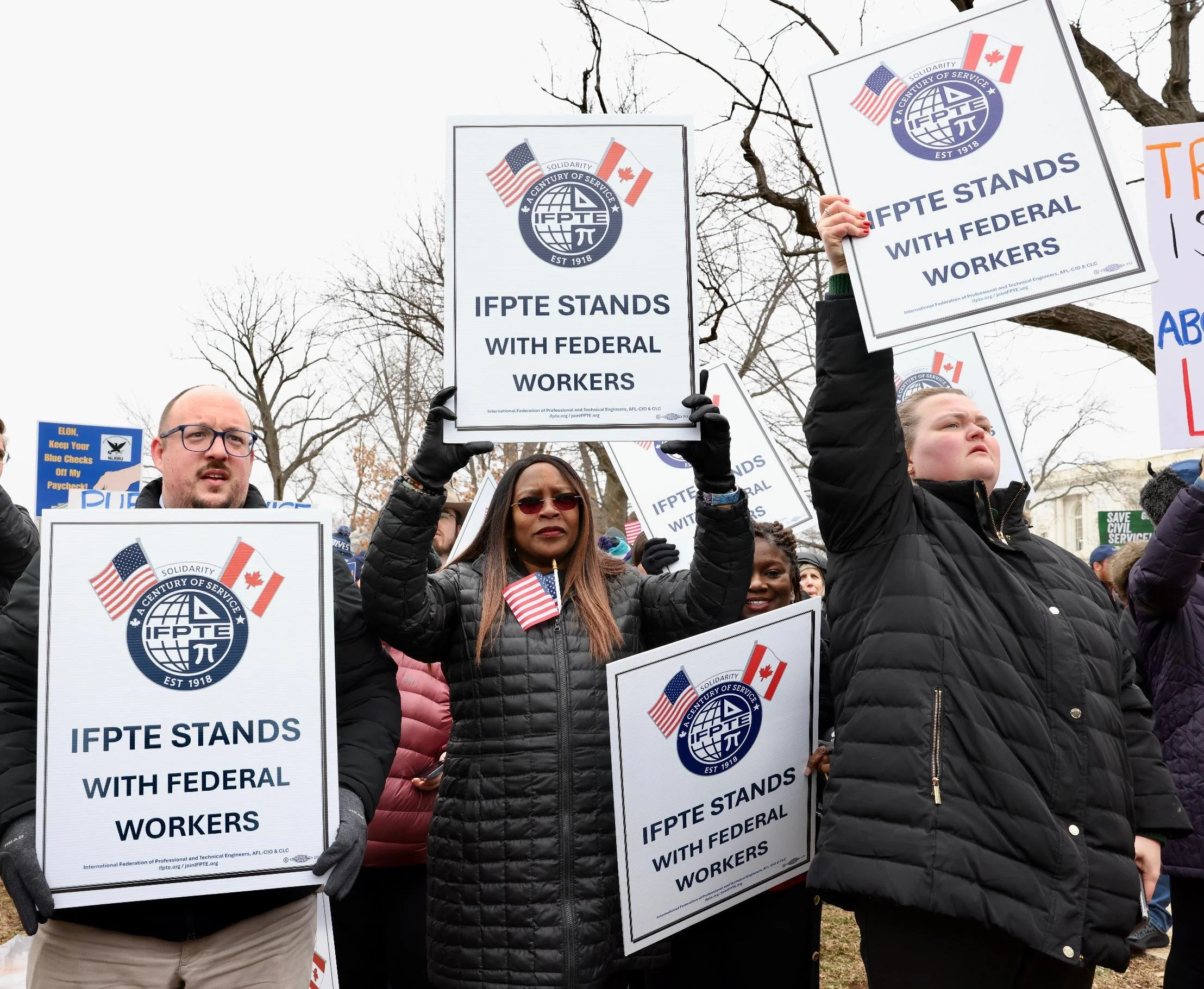
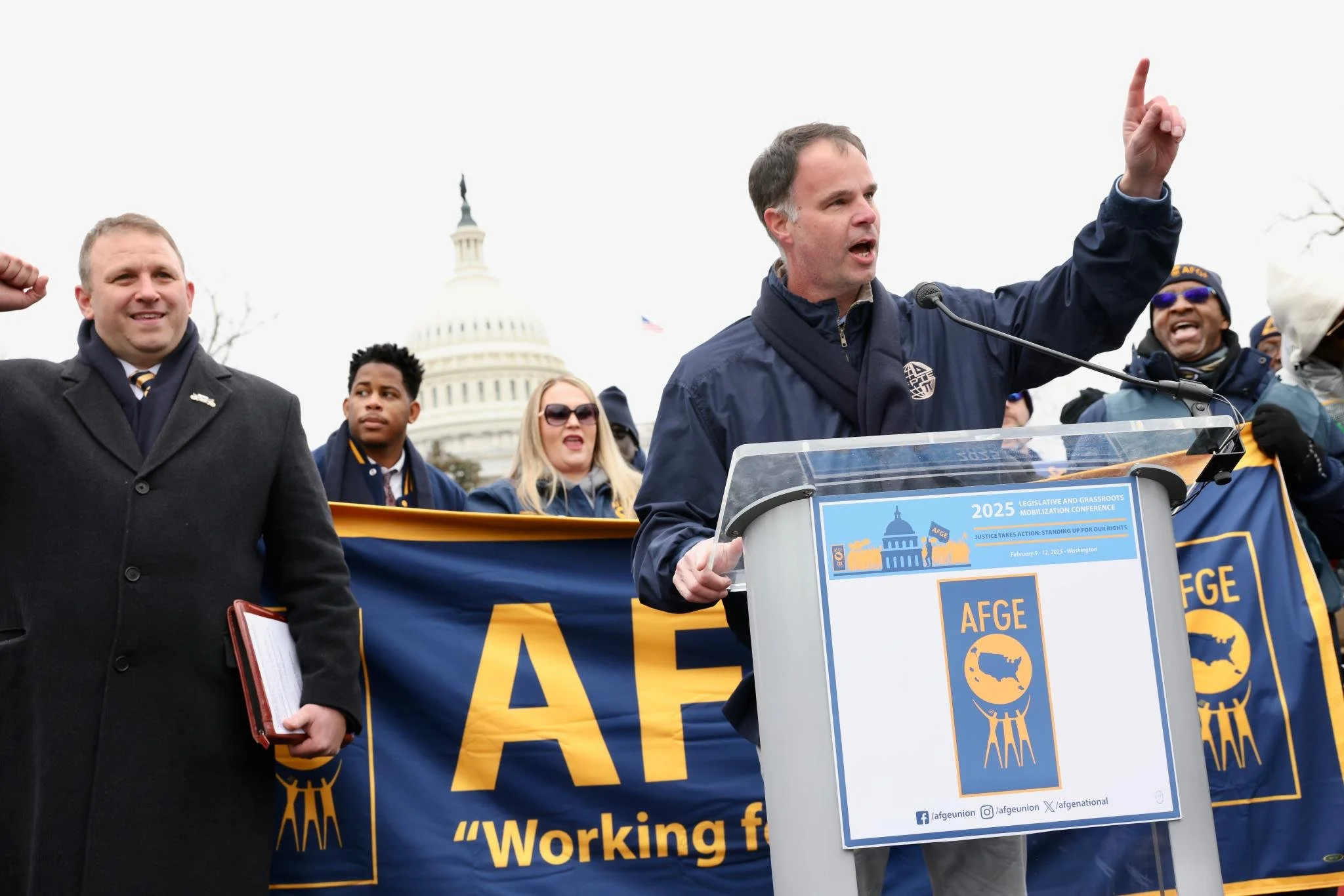
We reported here last week about IFPTE’s work in urging Congress to approve a federal employee pay increase as a part of the appropriations process. IFPTE continued that work with President Matt Biggs participating alongside AFGE President Everett Kelley, NTEU President Doreen Greenwald, and NFFE President Randy Erwin at a Capitol Hill press conference urging Congress to reject President Trump’s federal worker pay freeze proposal for 2027 by passing a 4.1% civilian pay increase as a part of the appropriations process.
The press conference was hosted by Representatives James Walkinshaw and Steny Hoyer, and Senator Chris Van Hollen and organized by the Federal Workforce Caucus. The caucus led a bipartisan letter signed by 110 congressional lawmakers last week urging congressional leadership to pass the 2027 pay increase before Congress adjourns later this year. For IFPTE’s part, Biggs called on Congress, “to approve a 4.1% pay raise, which is called for by the Fair Adjustment of Income Rates Act, as a part of the appropriations process,” while also calling the Trump Administration’s proposed pay freeze for most federal workers, “a disgrace and something our national lawmakers of all political stripes should be lining up to get corrected.” View President Biggs remarks here.
Last Wednesday, IFPTE also participated in a lobby day on Capitol Hill focused on defending and restoring collective bargaining rights for federal employees. The AFL-CIO-led lobby day included multiple Unions, including AFGE, NTEU, NFFE-IAM, American Federation of Teachers, International Brotherhood of Boilermakers, United Steelworkers, United Mineworkers, along with staff from the AFL-CIO legislative department, and the AFL-CIO's Department for Professional Employees (DPE), Metal Trades Department (MTD), and Transportation Trades Department (TTD).
Given that the House has already passed a National Defense Authorization Act (NDAA) for Fiscal Year 2027 (FY27) that includes Rep. Norcross’s bipartisan amendment that restores Department of Defense (DOD) employee collective bargaining rights, the lobby day was focused on making sure Senate offices know that the American labor movement request they prioritize an aggressive push to preserve the House-passed Norcross amendment as the House and Senate negotiate, or “conference,” a final NDAA. The union lobbyists also urged Senate offices to pass the Senate version (S.2837) of the Protect America’s Workforce Act (PAWA), which repeals the illegal executive orders signed by President Trump last year seeking to eliminate union rights from 1.3 million federal workers. Local 98 President Daniel Kim joined IFPTE staff for the Hill meetings.
While in Washington, Daniel Kim also made time to meet with key congressional offices in his continued efforts to block the United States Army Corps of Engineers (USACE) implementation of a costly and reckless office move from 98 Federal Plaza in New York to New Jersey. An internal Local 98 survey conducted earlier this year found that the move, which has been condemned by both Democratic and Republican members of Congress, would result in over half of the 407 represented members of Local 98 resigning their jobs. Kim, along with legislative director Khan, urged lawmakers to block the move pending a Government Accountability Office (GAO) investigation as to if the decision to move complies with legal and regulatory obligations and authorities.
Finally, the Senate is scheduled to remain in session through the end of this week, leaving on October 2nd. Members of the House and Senate are expected to return to D.C. on November 9, after the 2026 general election. Throughout the fall and into the post-election Congressional work period, IFPTE will continue coordinating with congressional staff in D.C. and in Congressional districts and states to advocate for our priorities, find opportunities to connect lawmakers with IFPTE Locals’ leadership, and monitor developments across all issue areas IFPTE members care about.
SOLIDARITY!
LEGISLATIVE:
FY27 Appropriations and FY27 NDAA - The FY27 NDAA passed through the House Armed Services Committee on June 5 and included IFPTE-backed legislative language championed by New Jersey Congressman, Donald Norcross, to restore collective bargaining rights for the nation’s DOD federal civilian workers. IFPTE will work on making sure the Senate and the House work towards a final House-Senate reconciled NDAA that restores bargaining rights for DOD employees.
In anticipation of Congress returning after the November elections to focus on passing FY27 appropriations, IFPTE will make sure lawmakers and Congressional staff understand the union’s funding priorities.
Protecting America’s Workforce Act - IFPTE continues to ask lawmakers to pass PAWA in FY27 appropriate appropriations measures as well as to pass the compromise House-Senate NDAA bill with language to retore DOD federal employees union rights. IFPTE is also working to grow the number of Senate Republicans cosponsoring the Senate PAWA bill (S. 2837).
NASA Reauthorization – NASA authorizers in the Senate and House are moving toward a compromise NASA reauthorization bill. IFPTE will continue to prioritize the protection of NASA’s science, aeronautics, and space technology research programs from efforts by the Trump Administration to dismantle them; urge Congress to protect NASA’s amazing scientists, engineers and administrative workforce, including ensuring NASA career paths for interns and term employees, and; include language similar to that included in the FY26 House NDAA to repeal the August 28th Trump union-busting order that included NASA.
2026 Water Resources Development Act (WRDA) - The bipartisan leadership of the House Transportation Committee has met with stakeholders, including IFPTE, to craft a 2026 WRDA reauthorization bill. While the House of Representatives passed the bill with an overwhelming support. This biannual legislation, which provides funding and authorization for the Army Corps of Engineers, is a legislative priority for the IFPTE International and the IFPTE Army Corps of Engineers (ACE) Council. With the help of all the IFPTE ACE Locals, and Local 561’s Michael Arendt, who represents the International on Capitol Hill along with IFPTE Legislative Director Faraz Khan on the WRDA bill, the issues of concern to IFPTE USACE membership will be worked on throughout this process. We will keep you all posted.
IFPTE has endorsed the Federal Worker Protection Act (H.R. 10198), sponsored by Rep. Eugene Vindman (D, VA-07) legislation that counters the Office of Personnel Management’s (OPM) proposed nondisclosure agreement (NDA) for federal workers, and instead provides federal whistleblowers protections against intimidation or retaliation related to protected disclosures. IFPTE continues to ask lawmakers to cosponsor HR 3093, The “Restoring Employment and Hiring Incentives for Removed Employees Act” or REHIRE Act to rebuild the federal workforce by providing a hiring preference for federal workers who were fired or otherwise involuntarily removed during the Trump Administration, and; HR 3094, the ‘‘Probationary Reduction for Employee Protections Act’’ or PREP Act would clarify that federal employees who are new to the competitive service have a 1-year probationary period, and employees who are moving to a new competitive service position from another position will have a 6-month probationary period. Both bills are authored by Congressman Don Beyer (D-VA), and IFPTE is encouraging Locals to also urge their House members to cosponsor these bills.
LEGAL:
On May 27, 2026, the U.S. Office of Personnel Management (OPM) issued a notice of a proposal to create a standardized nondisclosure agreement (NDA) for agencies to ask both new hires and current federal employees to sign as a condition of employment. If adopted, this unprecedented proposal would chill the speech of millions of federal employees, affecting what they can say to Congress, Inspectors General, unions, and the public. OPM connects the NDA to OPM’s broader suitability and fitness regulatory changes, warning that penalties could follow both violations of the NDA and the failure to sign. The notice also links to a proposed NDA that raises additional concerns. IFPTE submitted comments as well as signing onto coalition comments; over 31,000 comments were filed on this issue and we thank fellow unions, IFPTE locals, individuals, and coalition partners who submitted comments opposing OPM’s proposal.
Politicization of the FLRA - IFPTE joined a coalition of unions led by AFGE in a lawsuit filed in the U.S. District Court of Massachusetts on April 15, 2026, challenging the Trump Administration’s interim final rule shifting responsibility for handling representation petitions, unit determinations, election agreements, and certifications out of the hands of non-partisan, career FLRA Regional Directors to the national level Federal Labor Relations Authority itself, which is comprised of three political appointees. See the lawsuit here.
On June 29, Judge Casper (D. Mass) granted union plaintiffs' motion for summary judgment on the basis that the IFR was substantively arbitrary and capricious as well as having an arbitrary and capricious effective date. She chose not to reach plaintiffs’ notice and comment claims but did suggest that the IFR was not wholly procedural.
The parties have until July 6 to file a proposed final judgment vacating the IFR.
FMCS policy allowing unilateral agency rejection of requests for arbitrators – On April 22, 2026, the Federal Mediation and Conciliation Service (FMCS) published a memorandum containing a new policy requiring an affected federal agency to agree to an arbitration panel request, contrary to applicable FMCS regulations. On May 15, a coalition of unions, including IFPTE, sued to block this policy. The case was filed in DC District Court and has been assigned to Judge Randolph Moss. AFGE v. FMCS, Case No. 1:26-cv-01676 (D.D.C.).
Supreme Court sides with Trump administration in dispute over free speech rights of immigration judges: On May 26, 2026, the Supreme Court issued an unsigned order in Margolin v. National Association of Immigration Judges, No. 25-767. The National Association of Immigration Judges had challenged a 2021 policy requiring preclearance by their employer for public speaking engagements on First Amendment prior restraint grounds; the case had made its way to the 4th Circuit, which had remanded to the district court for proceedings consistent with its findings regarding the current operations of the MSPB, specifically that channeling claims individually under the CSRA to the administrative body of the MSPB might not be necessary if the body was not functioning as Congress intended.
The Supreme Court vacated and reversed this judgment, stating that the 4th Circuit had based its decision upon grounds that the parties had not presented. Of concern is the dissent of Justice Clarence Thomas, who wrote separately and was joined by Justice Amy Coney Barrett, to argue that federal law should be interpreted to say that civil servants must bring employment disputes to MSPB and if there is no MSPB, as was the case when the case was argued before the 4th Circuit, then federal civil servants are simply out of luck.Voting Rights Act Gutted by U.S. Supreme Court - On Wednesday, April 30, in the case Louisiana v. Callais, a 6-3 vote of a divided Supreme Court gutted Section 2 of the Voting Rights Act, which prohibits discrimination in voting, striking down a Louisiana Congressional map challenged by a group of voters who described themselves as “non-African American” as the product of unconstitutional racial gerrymandering. Justice Alito, writing for the majority, quoted the Supreme Court’s 2013 opinion in Shelby County v. Holder, which struck down the provision of the Voting Rights Act used to determine which state and local governments were required to obtain approval from the Department of Justice before making changes to their voting laws and practices. Alito wrote that “‘things have changed dramatically’” in the South “in the decades since the passage of the Voting Rights Act.”
Justice Elena Kagan read her dissent from the bench, a signal of her strong disagreement with the majority’s ruling. “The Voting Rights Act,” she wrote “is—or, now more accurately, was—‘one of the most consequential, efficacious, and amply justified exercises of federal legislative power in our Nation’s history.’ It was born of the literal blood of Union soldiers and civil rights marchers. It ushered in awe-inspiring change, bringing this Nation closer to fulfilling the ideals of democracy and racial equality.” And only Congress, Kagan argued, can “say it is no longer needed—not the Members of this Court.” She went on to state that the requirements now imposed upon Section 2 by the Court “will effectively insulate any practice, including any districting scheme, said by a State to have any race-neutral justification. That justification can sound in traditional districting criteria, or else can sound in politics and partisanship. As to the latter, the State need do nothing more than announce a partisan gerrymander... Assuming the State has left behind no smoking-gun evidence of a race-based motive (an almost fanciful prospect), Section 2 will play no role.”AFGE v. Trump, 3:25-cv-03070-JD - On February 26, the 9th Circuit issued an opinion overturning the (already stayed) preliminary injunction in AFGE v. Trump, 3:25-cv-03070-JD, the AFGE case challenging the 1st collective bargaining Executive Order primarily on 1st Amendment grounds. In its opinion, the 9th Circuit panel held that the district court had jurisdiction to address the challenge on its merits. This analysis is very helpful to us in our cases in dealing with any channeling arguments the government puts forth. The 9th Circuit panel also specifically stated that it was not opining on the potential merit of any ultra vires claim, i.e. that the EO is outside of the authority of the President. The case will therefore continue to proceed on its merits at the district court level in the Northern District of California. This does not directly affect IFPTE's cases but is informative and helpful as far as the question of district court jurisdiction. The opinion is available here.
Supreme Court Decision on Birthright Citizenship - On June 30, a divided Supreme Court issued a decision striking down the Trump Executive Order that attempted to end the 14th Amendment’s guarantee of birthright citizenship. IFPTE joined the labor amicus brief filed on February 24 in this case currently before the Supreme Court. The Supreme Court heard arguments in this case this past Wednesday, April 1st. The decision and dissents are available here; the labor amicus brief is available here.
Schedule P/C Amended Lawsuit - On March 4, Democracy Forward and co-counsel filed an amended complaint on behalf of public service organizations and unions, including IFPTE as an affiliate of the AFL-CIO and representative of MSPB administrative law judges and associated professions within the bargaining unit. The lawsuit challenges the Trump-Vance Administration's rule that unlawfully implements an executive order issued on January 20, 2025, titled "Restoring Accountability to Policy-Influencing Positions Within the Federal Workforce." The Executive Order and rule lay the groundwork to convert a significant percentage of the federal civil service from employees who can only be fired for cause to at-will employees who can be fired for any reason at all. Thousands of employees-including those who protect our public health, the environment and our food and water-who were hired for their expertise and who serve in non-partisan civil service positions could be stripped of vested job protections, in violation of their due process rights and more. See the GovExec article, which includes the amendment complaint, here.
Update on Status of Second IFPTE Lawsuit Challenging Union-busting EO - In December 2025, Judge Friedman issued an order staying IFPTE’s NASA case pending the outcome of various cases brought by AFSA, POPA, and NWSEA that were consolidated with the NTEU case challenging the first national security executive order. Oral argument for those cases occurred on December 15; we are currently awaiting a decision from the D.C. Circuit on the consolidated cases. Once the DC Circuit issues its decision, the parties will have 14 days to file a joint status report that will include proposals for how our case should proceed.
Legal Support for Federal Workers - Rise Up, Fight Back - Hundreds of thousands of federal workers have had their basic rights violated on the job—including tens of thousands who have been fired illegally. Federal workers have an urgent need for legal support and can now access a network of lawyers to help to get them the justice they deserve. See the September 30th GovExec article reporting on the Court’s granting of the preliminary injunction.
Status of all lawsuits against the current administration can be found at Just Security: “Litigation Tracker: Legal Challenges to Trump Administration Actions.”
GRASSROOTS:
“Civil Service Strong” coalition - IFPTE has partnered with the Civil Service Strong project of Democracy Forward, along with other unions, to support our members who are civil servants under attack by the Trump administration. Alongside the 95% of people who believe civil servants should be hired and promoted based on their merit rather than their political beliefs, Civil Service Strong is committed to supporting a career, non-partisan civil service and the people who power it. Learn more here.
MAKE A CALL – Restore Federal Employee Rights Now – IFPTE joins the AFL-CIO campaign asking every single American who cares about the fundamental freedom of all workers to join a union to call their member of Congress right now. Fill out the form to receive a call or dial 844-896-5059. Learn more here.